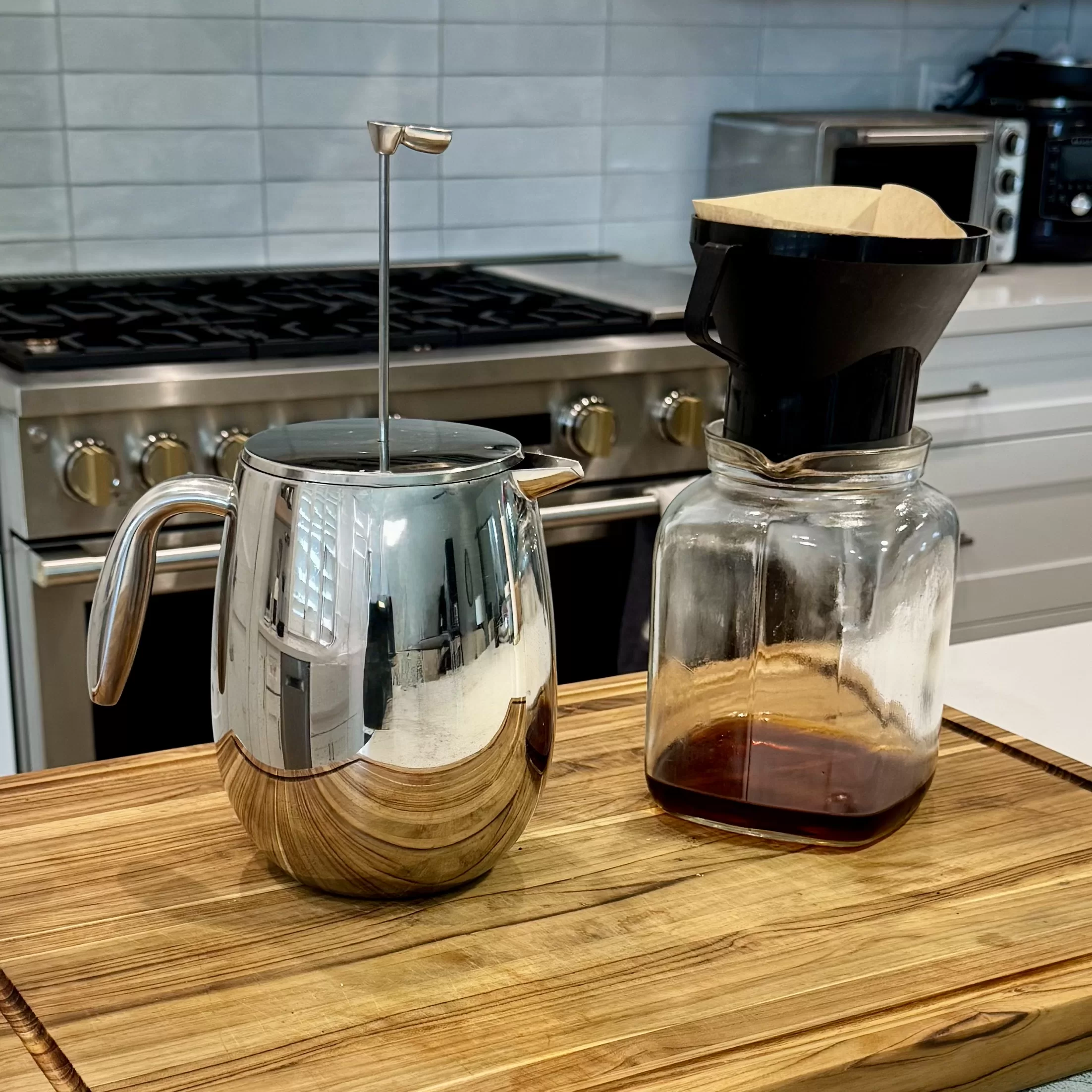
I am often surprised at how many people have never tried cold brew, let alone attempted to make it at home. I am here to say that it’s way easier than you’d think.
To make a high-quality cold brew at home, you don’t need expensive gadgets, just patience and a few kitchen staples. This method focuses on creating a potent concentrate that is smooth, naturally sweet, and significantly less acidic than hot-brewed coffee.
By using a two-step filtration process and a specific “double-stir” technique, you can achieve a professional-grade cup that stays fresh in your fridge for a week.
The Essentials
To start, here’s all you need:
- Your favorite coffee, preferably whole beans that you grind fresh at home. If you don’t have a grinder, then use whatever you like, coarsely ground
- Purified Water
- Equipment:
- Large French press, I use this one at home
- Large pourover-style coffee maker, like this one
- V60 paper coffee filters, like these
- A container to store your coffee.
- Bonus equipment
- Burr grinder
- Scale
Step-by-Step Instructions
1. Measure Your Beans
I use a 12-cup French press. You might be using a smaller French press. To make this work for you as well as it works for us, we will be talking in ratios. In my 12-cup French press, we weigh about 65 grams of coffee beans and fill the remaining French press with water. ChatGPT tells me that my ratio is roughly 1:23. If you’re using a normal 8-cup French press, this would mean that you’d want about 40 grams of coffee in your French press.
If you like it stronger or weaker, you can adjust accordingly. You may need to tinker a few times to get to your desired strength.
Trust the process
2. The Coarse Grind
Set your grinder to its coarsest setting. If the grind is too fine, your coffee will turn out muddy and bitter because it over-extracts during the long steep. Additionally, the coarse ground helps the filtration process.
Add your coarse coffee grounds to the French press.
*Option to add a pinch of salt.
3. The Initial “Bloom” and Stir
Pour the water over the grounds. Instead of stirring immediately, let it sit for 10 minutes. This allows the gas to escape and the water to fully saturate the “raft” of coffee. After 10 minutes, use a long spoon to stir the mixture thoroughly, ensuring no dry pockets remain.
*Note: This step is for the purest of coffee freaks. If you’re like me, you’ll just stir after adding water and move on with your life.
4. The Room-Temperature Steep
This is where the cold brew happens.
Cover the top of the French press (don’t use the plunger yet, as you want as much of the grounds in as much of the water as possible). Leave the press on your kitchen counter at room temperature for 12 to 24 hours. The longer the steep, the stronger the brew.
While some people prefer the fridge, room temperature extraction pulls out deeper chocolatey notes and sweetness more effectively.
5. The Pour
After 12 to 24 hours have passed, press down on the French press plunger.
Line your pourover coffee maker with a V60 paper filter. Place the pourover device over a large jar or container and carefully pour your cold brew through the filter. The French press will help keep out the large coarse grounds, while the V60 filter removes most of the fines, leaving you with the clearest and purest cold brew coffee.
6. The Storage
Store your cold brew in the refrigerator. It will stay fresh for up to 7 days.
How to Serve
Depending on how you made your cold brew, it could be too strong to enjoy straight. If you need to dilute it a bit, here are some helpful tips:
- The Golden Ratio: Mix 1 part concentrate with 1 part water (or milk).
- The Finishing Touch: Stir in a tiny pinch of kosher salt. This doesn’t make the coffee salty; instead, it neutralizes any remaining bitterness and highlights the bean’s natural caramel notes.
- Over Ice: Pour your diluted mixture over fresh ice. Since the coffee is already cold, the ice won’t melt as fast as it would with hot coffee, keeping your drink bold until the last sip.
Why This Works
- Patience over Heat: By avoiding hot water, you avoid “cooking” the beans, which prevents the release of acidic oils and makes your cold brew smooth.
- The Paper Filter Step: While a French press is convenient, its metal mesh is too porous for a truly “clean” cup. The secondary paper filtration is the difference between “good” home coffee and “great” cafe-style cold brew.
Not everybody has the time to make their own cold brew at home. That’s why Leg Up Cold Brew has your back. Find Leg Up Cold Brew near you, and get fueled up with Leg Up.